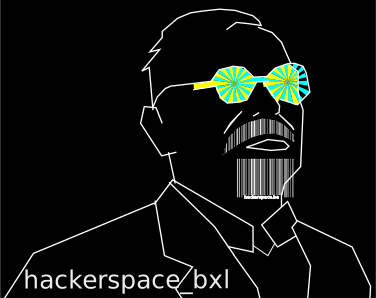
The dude on our logo is Norbert Wiener (1894-1964), the MIT mathematician who founded cybernetics. He has been the face of this space for about as long as the space has existed, and this page is here so you do not have to guess why.
The man
Wiener was the kind of prodigy that biographies are written about. He finished high school at eleven, took a maths degree at Tufts at fourteen, and had a Harvard doctorate in mathematical logic in 1913, before he turned nineteen. He went on to study with Bertrand Russell and G. H. Hardy at Cambridge and with David Hilbert at Göttingen, then spent the rest of his working life at MIT.
The maths he left behind is still in daily use. The Wiener process is the standard model of Brownian motion. The Wiener filter, worked out during the Second World War while he was building a predictor for anti-aircraft fire, is the reason a noisy signal can be cleaned up in a principled way rather than by taste.
Cybernetics
The anti-aircraft work is where the bigger idea came from. A gunner, a gun and a moving aeroplane form one system that measures its own error and corrects itself. Wiener noticed that the same shape appears in a thermostat, in a steam governor, in a hand reaching for a glass, and in an animal keeping its balance. In 1948 he named the study of that shape in Cybernetics: Or Control and Communication in the Animal and the Machine, from the Greek kybernetes, the steersman, because the steering engine of a ship was one of the earliest feedback mechanisms anyone built.
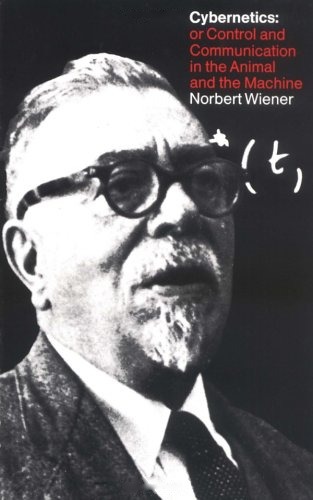
The book itself was an unlikely hit. It is a monograph with real mathematics in it, and it still went through printing after printing and turned cybernetics into a word ordinary people used. It also put its author in the public eye: the heavy black glasses, the goatee, and a blackboard never far behind him.
Feedback, error, signal and noise, the message as the unit of a system: that vocabulary came out of Wiener and the Macy conferences around him, and it is now so ordinary that nobody remembers it had to be invented.
Why we keep him
Because feedback is what actually happens in a hackerspace. You build the thing, you measure it, it is wrong, you correct it, you go around again. That loop is the whole method, and Wiener is the person who wrote down its mathematics.
Because he refused to stay in one discipline. Cybernetics was assembled out of mathematics, electrical engineering, neurophysiology, biology and philosophy, by someone who did not accept that those were separate buildings. On any given Tuesday the space contains a soldering iron, a radio, a bookscanner and an argument about ethics, which is roughly the same disposition.
Because he took responsibility for what he built. After Hiroshima he stopped accepting military work and government money, and said so in public in A Scientist Rebels in The Atlantic in January 1947. Refusing to hand your work to people you do not trust is a live question in this building too.
And because he saw the current argument coming, in detail, in 1960. In Some Moral and Technical Consequences of Automation, published in Science that May under the subtitle “As machines learn they may develop unforeseen strategies at rates that baffle their programmers”, he wrote:
If we use, to achieve our purposes, a mechanical agency with whose operation we cannot efficiently interfere once we have started it, because the action is so fast and irreversible that we have not the data to intervene before the action is complete, then we had better be quite sure that the purpose put into the machine is the purpose which we really desire and not merely a colorful imitation of it.
That is the alignment problem, sixty-odd years early, filed alongside the sorcerer’s apprentice and W. W. Jacobs’ monkey’s paw. He also wrote The Human Use of Human Beings in 1950 for a general audience, because he thought these were everyone’s problems and not a specialism.
He was not a saint
Worth saying, since we put him on the logo. His biography is called Dark Hero of the Information Age for a reason. In 1952 he cut off Warren McCulloch and Walter Pitts, two of his closest collaborators, without explanation and for good, and the reasons are still argued over. Pitts never really recovered. Admire the work, and read the footnotes.
The drawing
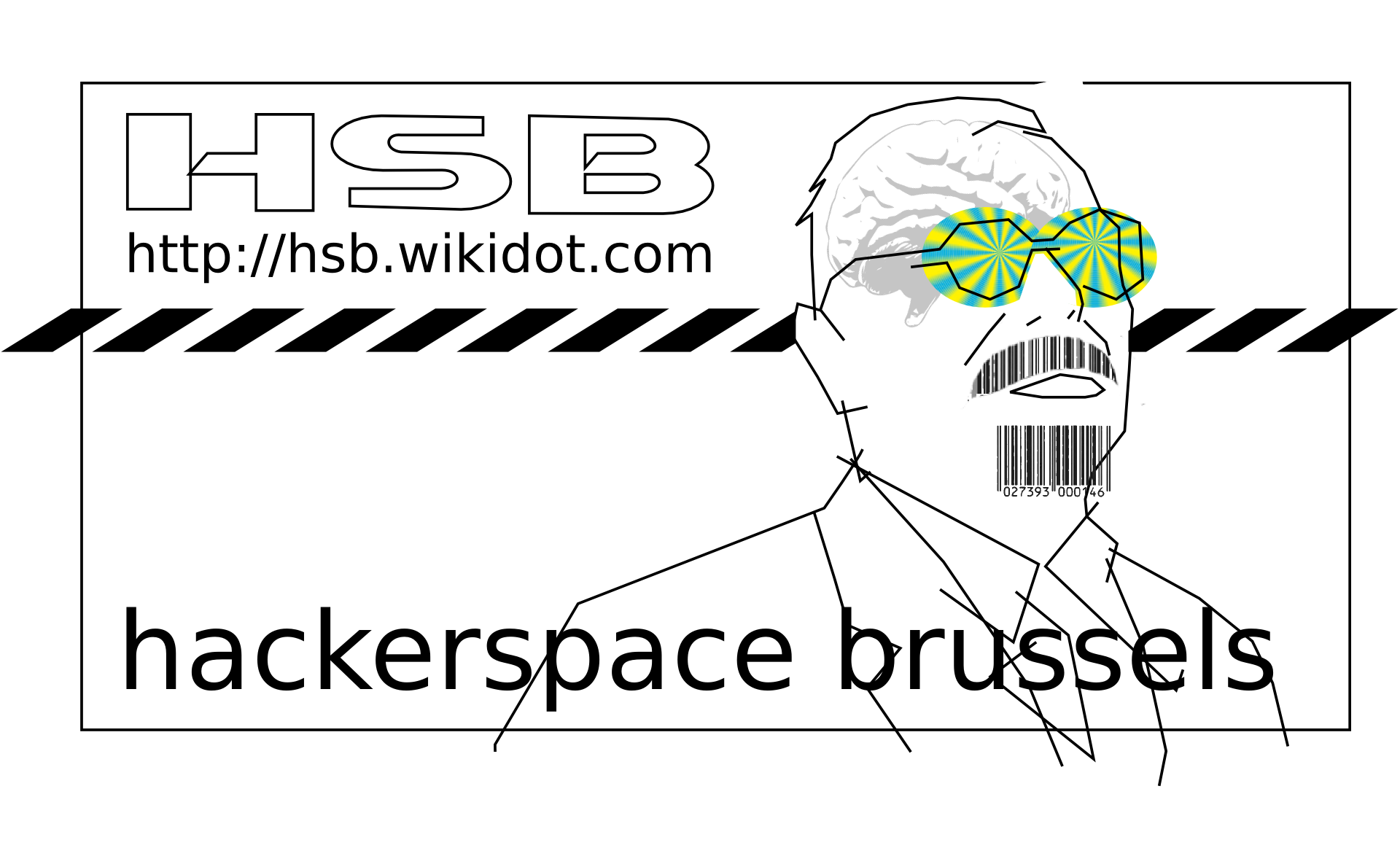
The artwork is a line-traced portrait of Wiener with a brain showing through the skull, a barcode where the moustache goes, and a pair of Mitch Altman’s Brain Machine goggles over the eyes. The Brain Machine is an open hardware sound and light machine from MAKE Volume 10 that flickers LEDs at brainwave frequencies, and it has been soldered together at hackerspace tables all over the world. The original wiki page put it plainly:
Basically it’s just a cool dude, overlayed with brainmachine (out of Mitch Altman Makers' shed) and FOSDEM brainz.
The banner above was uploaded by Sandb on 30 September 2009, back when the space lived at
hsb.wikidot.com. The vector master at the top of this page is norbert.svg, uploaded by
ptr_ on 8 October 2009 with the entire description “use inkscape to edit”. Both come from
the archived wiki, and both are under the GFDL 1.2 that covers it.
He has not gone unchallenged. The wiki’s sticker page is a long trail of members proposing alternative designs, none of which ever replaced him.
A Brussels footnote
Cybernetics has roots in this city. In 1993, barely two years after the Web went public, the Principia Cybernetica Web went online at the VUB in Brussels and became one of the largest sites on the early Web. Wiener’s vocabulary was being maintained a few kilometres from here while most of the internet was still text files.
Read more
- Norbert Wiener on Wikipedia
- Ex-Prodigy and I Am a Mathematician, his two volumes of autobiography, free from MIT Press
- The Norbert Wiener papers at the MIT archives
- Out of Control, chapter 7, where Kevin Kelly retells how a mathematics monograph became a 1948 bestseller
- The Charismatic Cultural Life of Cybernetics, a 2017 paper on Wiener as an early media-visible scientist
- The 1965 MIT Press paperback of Cybernetics in the Open Library catalogue
- The original wiki page this one replaces, last edited in August 2010
- Hacker News has been chewing on him for years, most usefully on his relationship with Russell and on the original AI doomer



